The Multi-Petabyte Challenge: Why Conventional Tools Fail at Data Center Consolidation
February 24, 2026
Enterprise data center consolidation stands as one of the most critical and complex IT initiatives. The strategic goals—reducing costs, improving efficiency, and enhancing agility—are clear. However, the operational path is fraught with a monumental obstacle: the secure, reliable, and timely migration of petabyte-scale data assets. When legacy systems, decades of accumulated data, and business continuity requirements converge, traditional migration tools and methods often buckle under the pressure, turning strategic projects into costly, high-risk ordeals.
The Limitations of "Good Enough" Solutions:
Many organizations initially turn to familiar tools, only to encounter significant roadblocks at scale:
-
Native OS Tools (Robocopy, rsync): While useful for ad-hoc tasks, they lack centralized control, comprehensive error handling, and real-time visibility for petabyte-scale operations. They become unmanageable and unreliable over long-distance WAN transfers, with no built-in acceleration or automated restart capabilities.
-
General-Purpose Cloud Storage Gateways: These can introduce abstraction layers and egress costs that complicate large-scale, direct data center-to-data center moves. Performance is often inconsistent, and they may not provide the granular security controls or detailed audit trails required for sensitive enterprise data.
-
Basic FTP Servers or Open-Source Transfer Tools: They simply cannot handle the throughput requirements. Lack of acceleration protocols leads to painfully slow transfer times over any significant distance, making project timelines unpredictable and stretching over months. They also typically lack the enterprise-grade security and detailed reporting needed for such a critical project.
The result? Blown deadlines, skyrocketing bandwidth costs, unforeseen security exposures, and a tangible risk of data loss or corruption. The consolidation project, intended to create efficiency, instead consumes excessive IT resources and creates business disruption.
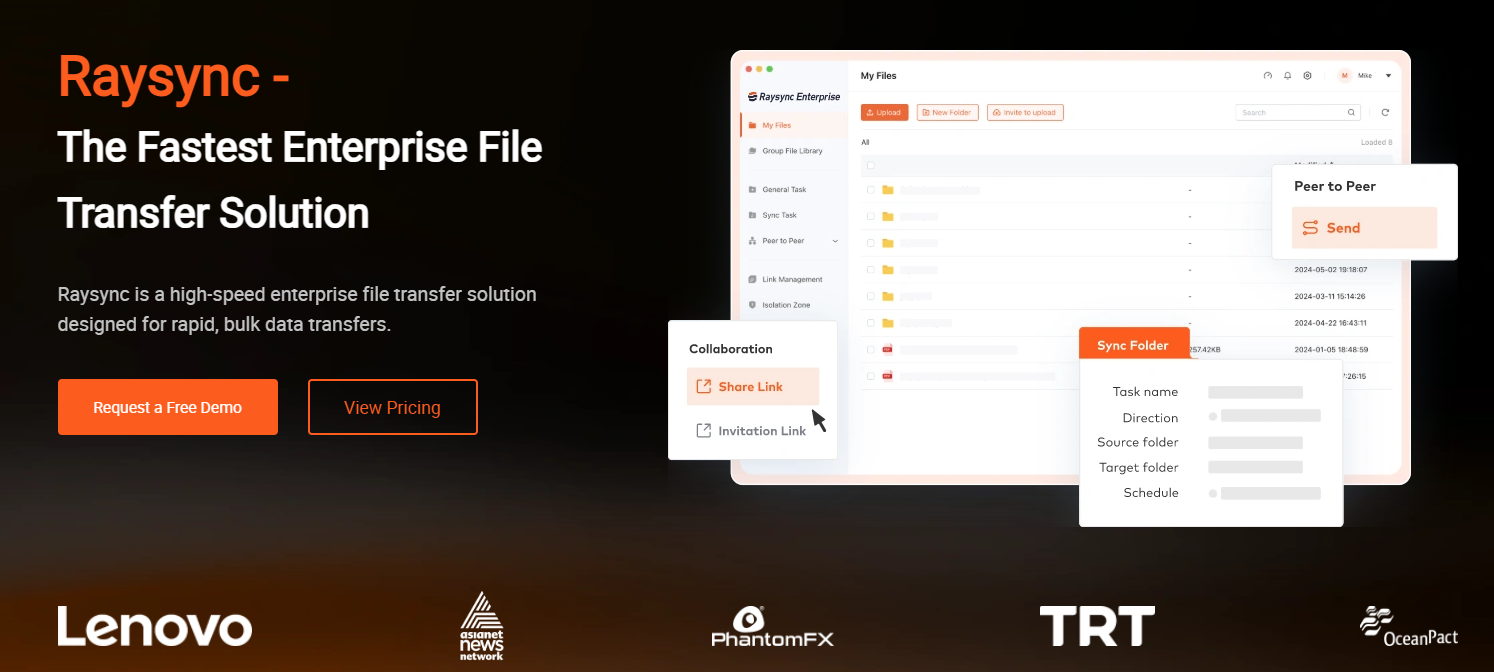
Raysync: The Engineered Solution for Petabyte-Scale Data Center Migration
When moving the foundational data of your enterprise, you need a tool built for the singular purpose of high-speed, reliable, and secure large-scale data migration. This is the core mission of Raysync—it is not a general utility, but a specialized enterprise file transfer solution engineered to turn your data center consolidation from a high-anxiety project into a predictable, managed process.
Why Raysync Succeeds Where Other Methods Struggle:
1. Unmatched Transfer Speed for Predictable Timelines:
Raysync's proprietary acceleration protocol is designed to overcome the fundamental limitations of TCP that cripple traditional tools over WAN links. By utilizing intelligent UDP-based streaming, parallel transfer sessions, and dynamic bandwidth optimization, Raysync achieves consistent, maximum utilization of your available network pipe. This can reduce migration windows from months to weeks or even days, providing the predictability essential for project planning and minimizing business impact.
2. Military-Grade Security and Data Integrity:
A consolidation move cannot compromise security. Raysync provides end-to-end AES-256 encryption for all data in transit and at rest. Every file transfer is verified with automatic checksum validation, guaranteeing bit-for-bit accuracy and eliminating the risk of silent data corruption. Detailed audit logs of every action create an immutable chain of custody for compliance and verification.
3. Centralized Control and Operational Resilience:
Manage your entire multi-petabyte migration from a single pane of glass. Raysync provides:
-
Real-Time Global Dashboard: Monitor all concurrent transfer jobs, global throughput, and system health instantly.
-
Intelligent Job Management: Set up automated, scheduled transfer tasks with retry logic and failure notifications. Prioritize critical data sets.
-
Bandwidth Optimization: Apply policies to throttle speeds during business hours or allocate maximum bandwidth to migration streams during off-peak windows.
4. Built for the Enterprise Scale and Ecosystem:
-
Unlimited Scalability: Architecturally designed to handle billions of files and exabytes of data without performance degradation.
-
Flexible Deployment: Deploy on-premises, in the cloud, or in a hybrid model to suit your consolidation architecture.
-
Seamless Integration: Robust RESTful APIs allow you to embed Raysync's transfer engine into existing orchestration, storage, and management platforms.
From High-Risk Project to Managed Process
With Raysync, data center consolidation transforms. It moves from being a daunting, one-off "lift-and-shift" event to a controlled, auditable, and repeatable operational procedure. IT leaders gain confidence from real-time progress tracking, guaranteed data fidelity, and the ability to meet strict project deadlines.
Do not let legacy tools dictate the timeline and success of your most critical infrastructure initiative.
Choose Raysync—the performance and reliability engine purpose-built for petabyte-scale enterprise data migration.
Contact us today to schedule a detailed consultation and see how a customized Raysync proof-of-concept can de-risk your consolidation roadmap and ensure its success.
You might also like
Industry news
September 27, 2024Data dilemma? Find your storage solution match. Discover the 3 essential steps to choose the best data storage solution for your business.

Industry news
April 17, 2025Considering OneDrive for Business? Our in-depth purchasing guide offers a human-friendly review, highlighting key features, pricing, and benefits. Make an informed decision before you buy.
![Everything About iPerf3 Speed Test [2025 Updated]](http://images.ctfassets.net/iz0mtfla8bmk/pwBbAd6INkSNiJiVkgW7s/5fbb9a7105244e5efd7f0a675da51080/iperf3-speed-test.png)
Industry news
March 7, 2025Frustrated with buffering? An iperf3 speed test can pinpoint network bottlenecks. See your bandwidth in action and understand your connection.