Why Bandwidth Isn't Enough: The Critical Roles of Latency and Protocol in Global File Transfer
December 12, 2025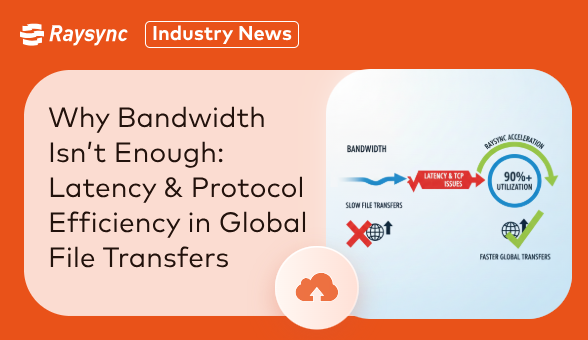
In the race to accelerate global business operations, many organizations operate under a fundamental misconception: that upgrading bandwidth alone will solve their file transfer challenges. The reality is far more complex. While bandwidth represents the width of your data highway, it tells only half the story. To achieve truly accelerated global transfers, you must understand and address the critical factors of latency and transfer protocol efficiency.
The Bandwidth Myth: Why Bigger Pipes Aren't Always the Answer
Imagine bandwidth as the number of lanes on a highway. While more lanes allow more cars to travel simultaneously, they do nothing to address the fundamental distance between cities (latency) or the efficiency of each vehicle's engine (protocol efficiency).
-
The Physics Problem: Data cannot travel faster than the speed of light. The physical distance between New York and Singapore will always create inherent delay, regardless of your bandwidth.
-
The Protocol Problem: Traditional protocols like TCP were designed for reliability, not speed. They create significant overhead that becomes exponentially worse with distance.
The Result: You may have invested in a 10Gbps connection, but find your international file transfers utilizing only a fraction of that capacity.
The Hidden Culprits: How Latency and Protocol Inefficiency Throttle Your Transfers
1. The Latency Penalty: Why Distance Still Matters
Latency is the delay between sending a data packet and receiving acknowledgment. Each round-trip acknowledgment (TCP ACK) creates waiting time.
Example: New York to London
-Distance: ~5,600 km
-Theoretical minimum latency: ~28ms
-Real-world latency: ~65-80ms
-Each TCP handshake adds multiple round trips
-Result: Significant time spent waiting, not transferring
2. The TCP Bottleneck: A Protocol Showing Its Age
The TCP protocol, while reliable, was never designed for high-speed, long-distance transfers:
-
Congestion Control Overkill: TCP's "slow start" mechanism dramatically underutilizes available bandwidth on high-latency links
-
Packet Loss Panic: A single lost packet can halve your transfer speed as TCP aggressively reduces transmission rates
-
Inefficient Acknowledgments: The constant back-and-forth communication creates massive overhead on global links
Raysync's Solution: Overcoming Physics with Intelligence
Raysync addresses these fundamental limitations through a revolutionary approach to file transfer.
1. Proprietary UDP-Based Protocol
We've rebuilt the foundation of data transfer from the ground up:
-
Eliminates TCP Handshakes: Our protocol minimizes the "chatty" acknowledgments that create latency-induced delays
-
Intelligent Error Correction: Uses forward error correction to handle packet loss without performance-killing retransmissions
-
Dynamic Congestion Control: Adapts to network conditions in real-time, maintaining high utilization without causing congestion
2. Latency Optimization Technology
Raysync doesn't just tolerate latency—it actively works around it:
-
Parallel Stream Management: Creates multiple simultaneous data streams to fill the "pipe" continuously
-
Connection Pooling: Maintains optimized pathways for recurring transfer routes
Case Study: Global Media Company
Challenge: Transfer daily 4K broadcast footage between London and Sydney (350ms latency) despite having 10Gbps dedicated links.
TCP Performance: Transfers took 6-8 hours, utilizing only 20-30% of available bandwidth.
Raysync Solution: Achieved consistent 90%+ bandwidth utilization, reducing transfer times to under 90 minutes.
Why Raysync Delivers What Bandwidth Alone Cannot
For Global Enterprises Maximize your existing infrastructure investments by actually using the bandwidth you're paying for.
- Adaptive Rate Control
Dynamically adjusts transmission rates based on latency and packet loss
- Multi-channel Transfer
Utilizes multiple network channels simultaneously to bypass congested routes
- Zero Buffer Copy
Reduces CPU overhead and minimizes internal processing delays
- Intelligent Compression
Reduces the actual amount of data that needs to travel long distances
Stop Blaming Your Bandwidth Start Optimizing Your Transfers
The evidence is clear: throwing bandwidth at the problem of slow global file transfers is expensive and ineffective. The real solution lies in addressing the fundamental limitations of latency and protocol efficiency.
Ready to Experience the Difference?
About Raysync
Raysync's next-generation file transfer technology is specifically engineered to overcome the limitations of distance and outdated protocols. By maximizing bandwidth utilization regardless of latency, we help global enterprises achieve transfer speeds that were previously physically impossible.
You might also like

Industry news
October 28, 2025VFX file transfer solution, raysync, case study, fractal picture, large file transfer, enterprise large file transfer, vfx studio
![Detailed Explanation of P2P File Sharing [Latest Update]](http://images.ctfassets.net/iz0mtfla8bmk/2LS815ZEsA04ub0xlM8mZd/13c5e6ee6aa13df41e18db928e6ec499/p2p-file-sharing.png)
Industry news
July 10, 2024Discover the best P2P file sharing tools: uTorrent for fast downloads and efficiency, qBittorrent for open-source reliability, and BitTorrent for decentralized file distribution.

Industry news
September 19, 2024Find the best data transfer solutions for your enterprise in 2025. Learn about the latest data transfer technologies, including cloud-based, high-speed, and managed data transfer platforms.